Dresses for Petite Frames: The Cuts, Lengths and Details That Add Inches
Quick Answer: For petite frames, the waist seam must land at your natural waist — a dropped waist is the single most shortening detail in dressmaking. Hem at or above the knee, or a midi that hits the narrowest part of your calf. Keep prints and details small-scale, and finish with a nude-to-you shoe so the leg line continues past the hem.
The dress is the highest-stakes garment in a petite wardrobe, because it makes every proportion decision for you at once. You don’t get to fix a bad waist placement by swapping the trousers. It’s one piece, one verdict.
Which cuts both ways. Get the cut right and a dress is the fastest five-minute outfit you own — no coordinating, no thinking, just add shoes.
What Should Petite Women Look for in a Dress?
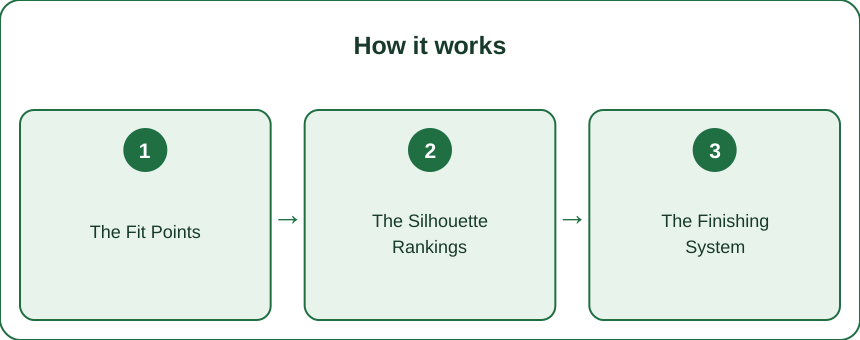
Five fit points, in order of how much they matter.
1. The waist seam lands at your natural waist. This is the whole game. A dress that defines your waist at the narrowest point splits your body into a shorter top half and a longer bottom half, which reads as longer legs. A dropped waist does the exact opposite and is genuinely petite kryptonite — it shortens the leg line by the full distance it drops. Empire and natural-waist cuts are the reliable choices.
2. The hem hits a narrow point. Not an arbitrary length — your narrow point. Just above the knee and at the knee are the two most reliable spots. A midi works when it hits the slimmest part of your calf; hit the widest part instead and it visually stops your leg dead. Maxis should graze the floor with your shoes on, never pool.
3. Shoulder seams sit at your shoulder edge. Not down your arm. This one detail decides whether a dress reads as tailored or borrowed, and it’s the hardest thing to fix afterwards.
4. Details are scaled to your frame. Small-to-medium prints, modest ruffles, proportionate pockets and collars. An oversized floral wears you rather than the reverse — the print should be a feature, not the whole event.
5. Vertical lines are built in. Button-front plackets, V-necks, princess seaming, a centre-front slit. These are free height, sewn into the garment.
Which Dress Silhouettes Work Best for Petite Frames?
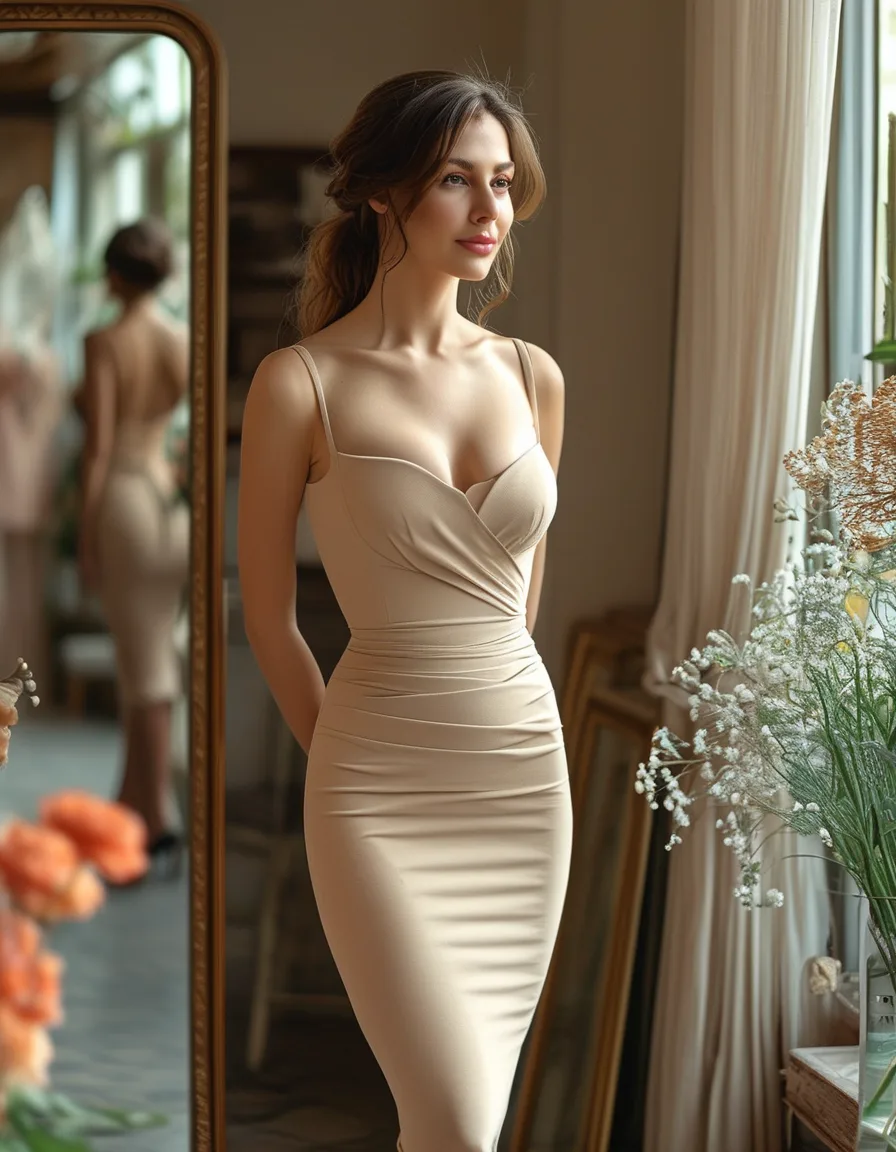
The wrap dress — the champion. Adjustable waist definition exactly where you want it, a V-neck that lengthens the neck and torso, and a diagonal line that keeps the eye moving. Tie it at your natural waist, not below.
Fit-and-flare — the classic formula. Defined waist, skirt that skims. The knee-length version is the petite standard for a reason and works for almost every occasion.
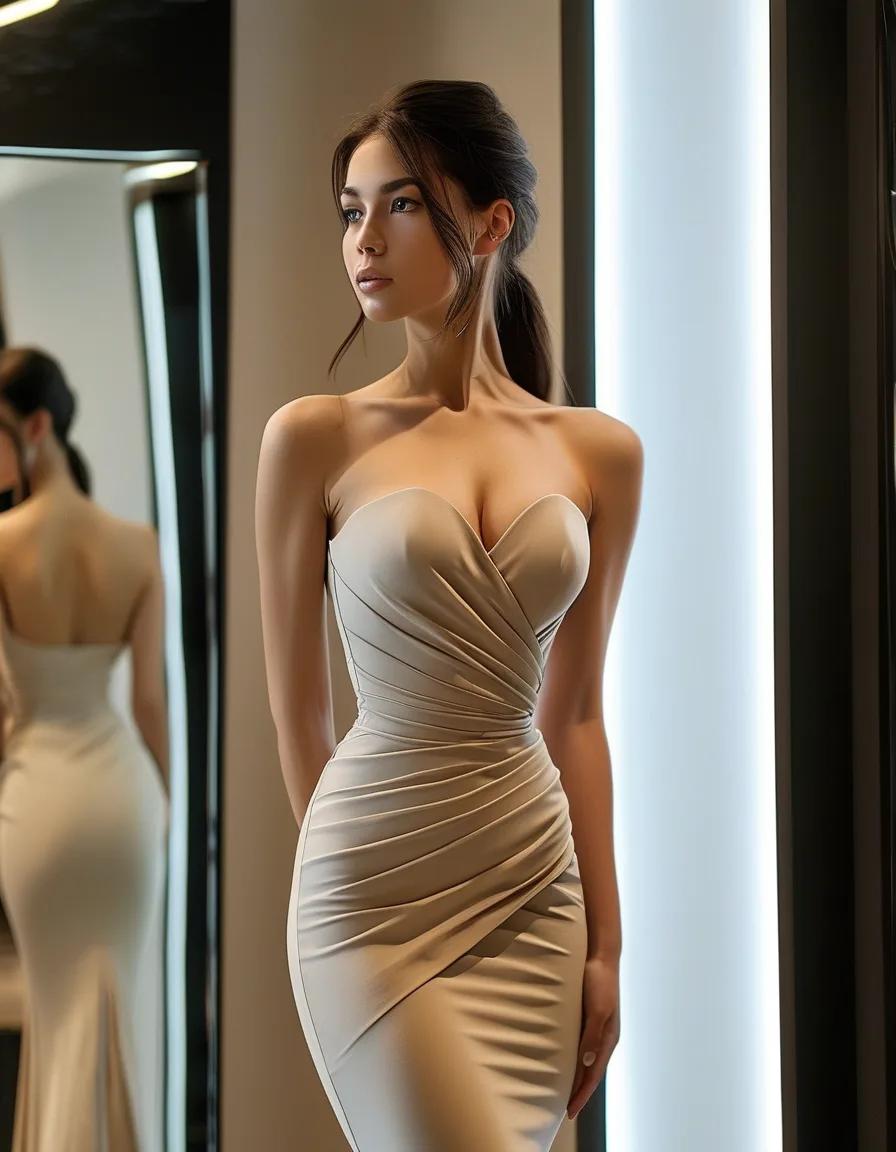
Sheath and column dresses — excellent, but tailoring-dependent. A clean fitted line creates a single unbroken column, especially in one colour, which is the strongest lengthening effect available. The catch is that these are honest about fit; a sheath that’s slightly wrong looks slightly wrong all day.
Shirt dresses — always belt them. Unbelted, a shirt dress is a rectangle, and a rectangle swallows a small frame. Belt it, cuff the sleeves, and leave the bottom couple of buttons open to show some leg.
Slip dresses — length is everything. Bias-cut fabric skims beautifully, but mid-shin is the one length to avoid entirely. Go ankle-grazing or knee.
The caution tier: drop-waist dresses, stiff mid-calf A-lines, and extreme tiered volume. None are impossible, but they all demand heels and conviction. Translate the trend rather than adopting it wholesale.
The Finishing System
Styling is where a good dress becomes a great outfit.
- Shoes in your skin tone. Nude-to-you pumps or pointed flats continue the leg line past the hem instead of cutting it off. This is the highest-leverage styling move in petite dressing, full stop. Ankle straps do the opposite — save them for longer hems.
- Match your tights to your shoes in cold months. A tonal run from hem to toe creates one unbroken column, and it’s the reason winter can actually be easier than summer.
- Keep a few skinny belts. They define a waist without adding bulk, and they rescue every shapeless candidate in your wardrobe.
- Layer short. Cropped cardigans and waist-length jackets keep the hem high. A longline coat over a dress works only when there’s a matching column underneath.
- Scale accessories down. Delicate jewellery, small-to-medium bags. A necklace with a V-shaped drop echoes and reinforces a V-neck.
- Find a tailor. Hemming to your narrow point costs very little and is the closest thing to a transformation in this whole guide. Shortening straps and nipping a waist are on the same cheap menu. Buy for the shoulders, tailor everything else.
Building the Collection
Four dresses cover almost everything:
- A wrap dress for the widest range of occasions.
- A fit-and-flare for events and anything requiring a bit of polish.
- A sheath for work.
- A casual knit or tee dress for weekends.
Rotate seasonally — sundresses with flat sandals in summer, sweater dresses with boots and matched tights in winter. Shop petite lines first, since they’re graded for shorter torsos and arms rather than just shortened at the hem, and read reviews specifically for where the waist seam lands. Then dial any of the four up or down with accessories; the same wrap dress runs errands and goes out to dinner on a change of shoes and earrings.
5 Mistakes Everyone Makes Shopping for Petite Dresses
1. Buying a size down to fix the length. A smaller size shortens the hem but also tightens the shoulders and bust, which is the one place you can’t alter your way out of. Buy for the shoulders, tailor the hem.
2. Ignoring where the waist seam lands. The most consequential detail on the garment, and the one nobody checks in the fitting room. If it’s sitting below your natural waist, put it back.
3. Assuming “petite” just means shorter. Proper petite lines re-grade the whole pattern — torso length, dart placement, sleeve, rise. That’s why a petite size often fits straight off the rack when a hemmed regular size still looks off.
4. Wearing an ankle-strap shoe with a knee-length hem. The strap cuts the leg at exactly the wrong point. Save straps for longer hems and use a plain nude-to-you shoe with anything at or above the knee.
5. Scaling up the accessories to “balance” the dress. An oversized bag or a chunky necklace doesn’t balance a small frame — it competes with it. Small-to-medium, always.
Mini FAQ
What dress length is most flattering for petite women?
At or just above the knee is the most reliably flattering, because it shows the most leg without the hem cutting across a wide point. Midis absolutely work — they just need to hit the narrowest part of your calf, which is usually a couple of inches below where a standard midi falls, so hemming is often required.
Should petite women avoid maxi dresses?
Not at all, but the hem has to be right. A maxi should graze the floor with the shoes you’ll wear, never pool or drag, and a vertical element — a front slit, a button placket, a defined waist — keeps it from reading as a column of fabric. Getting one hemmed transforms it.
Do petite sizes actually fit differently?
Yes, meaningfully. Petite lines shorten the torso, adjust where the waist and bust darts land, and shorten sleeves and rise — not just the hem. That’s why a petite-size dress often fits well straight off the rack while a regular size in the same style needs three alterations.
TL;DR
- Waist seam at your natural waist. Drop waists shorten the leg line the most.
- Hem at or above the knee, or a midi that lands at your narrowest calf point.
- Wrap and fit-and-flare are the most reliable silhouettes; belt every shirt dress.
- Scale prints and details small; look for built-in vertical lines.
- Nude-to-you shoes continue the leg past the hem — the biggest styling win available.
- Buy for the shoulders, tailor the hem. It’s the cheapest transformation there is.
Waist high, hem at the narrow point, shoes in your leg’s tone — and the proportions take care of themselves.
See It in Motion
Seen here: High Waist Yoga Leggings with Side Pockets — shop it on bubblelime.com
Keep Reading
This article is for general informational and styling purposes only. Fit, sizing, and product availability may vary.