Why Pocket Placement Decides Whether a Petite Garment Looks Right
Quick Answer: Pockets are positioned relative to a garment’s overall length and the wearer’s assumed torso proportions, and on a standard-sized garment those assumptions are for a taller frame. When a garment is graded down in size but not in proportion, the pockets sit too low, too wide apart, and too large relative to the body — which shortens the torso visually, widens the hip line, and is the most common reason a technically well-fitting piece still looks slightly off. It is also one of the easier things to fix or to shop around.
The shoulders fit. The sleeves are the right length after tailoring. Something is still wrong.
It is frequently the pockets, and once you see it you cannot unsee it.

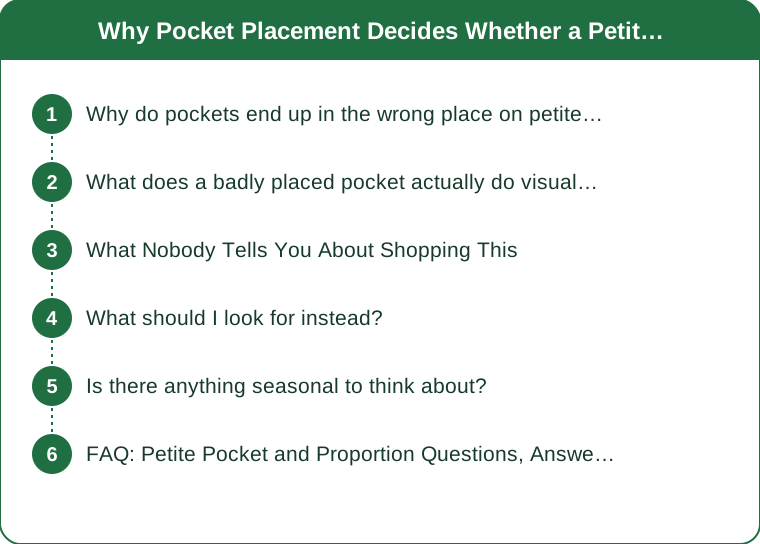
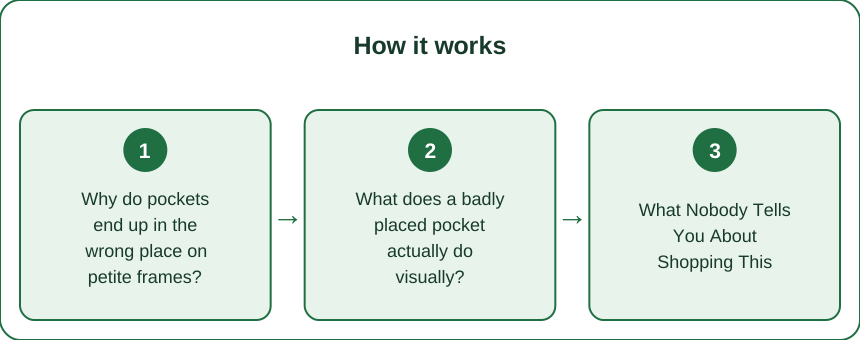
Why do pockets end up in the wrong place on petite frames?
Because of how garments are graded between sizes.
When a manufacturer creates a size range from a base pattern, they grade it — scaling measurements up and down according to a set of rules. Grading primarily adjusts girth: bust, waist, hip. Vertical proportions and detail placement are frequently adjusted much less, or not at all, because doing so properly requires redrawing the pattern rather than scaling it.
So a size 8 and a size 16 of the same jacket often have pockets at nearly the same height from the shoulder, even though the bodies inside them are different.
For petite frames, this compounds with a separate issue: the difference is mostly in torso and limb length, not girth. Someone at 155cm may have essentially the same bust measurement as someone at 172cm, and buying by that measurement gets you a garment whose vertical geometry belongs to the taller body.
What that produces:
Pockets sitting too low, often at or below the widest part of the hip, when they were designed to sit above it.
Pockets too far apart, because horizontal placement was scaled for a wider frame.
Pockets too large, which changes the visual scale of the whole garment.
Flap and welt details that read as oversized, because their dimensions were never graded at all.
Do true petite lines fix this?
Good ones do, by redrawing rather than shortening. Many so-called petite ranges only shorten sleeves and hems, which leaves pockets and other details in their original positions. This is the fastest way to tell a real petite line from a shortened standard one — look at where the pockets sit relative to the hem.
What does a badly placed pocket actually do visually?
Three specific things, all of which work against a petite frame.
It creates a horizontal line at the wrong height. A pocket is a strong horizontal detail. Wherever it sits, the eye registers a boundary. If it lands at the widest part of the hip, it draws a line exactly where you would least choose one, and it visually divides the body at that point.
It sets the apparent waist. On a jacket, the eye reads the pocket line as a proportional marker, and a low pocket line drops the apparent waist. That lengthens the torso and shortens the leg — the opposite of what most petite styling is trying to achieve.
It changes the perceived scale of the whole garment. A large patch pocket on a small frame makes the garment read as borrowed. This is the same effect as oversized buttons or a wide lapel, and it is why scale of detail matters as much as fit.
There is also a practical dimension: a pocket placed for a longer arm sits at an awkward height for a shorter one, so hands go in at an odd angle, which affects how the garment sits when worn naturally rather than when photographed still.
Where pockets should sit, as a rough guide:
- Jacket pockets ideally sit above the widest point of the hip, roughly at or slightly below the natural waist to high hip.
- Trouser front pockets should open at a point that follows the hip curve rather than gaping across it.
- Back trouser pockets placed too low elongate the seat; too high and they read oddly. The centre of the pocket sitting at the fullest part is the usual target.
- Patch pockets on a coat are the most visually dominant, and therefore the most important to get right.
What Nobody Tells You About Shopping This
Check the pocket before you check the length. Hem length is the cheapest alteration in tailoring. Pocket placement is expensive to change and sometimes impossible. Shop for details you cannot move, and alter the things you can.
Back trouser pockets are the most alterable of the lot. They can genuinely be unpicked and repositioned by a good tailor, and it is not as expensive as people assume. Front pockets and jacket pockets are far harder.
Pocketless is a real option and it is under-considered. A jacket with welt pockets that are sewn shut — as many are when new — can simply be left shut, and the visual line is much weaker than an open pocket. Some people have the welts removed entirely.
Cross-body bag straps interact with pocket lines. A strap creates a strong diagonal, and where it crosses a pocket line the two details compete. Worth noticing when a combination feels busy and you cannot say why.
Patch pockets can be removed. On a coat or a casual jacket, a tailor can take a patch pocket off and reposition it, and the marks left behind are often manageable on a textured fabric. On a smooth fabric it will show.
Kids’ and teens’ ranges are not a solution. They solve length and create problems everywhere else, particularly through the bust and shoulder, and detail scale is drawn for a different body shape entirely.
The best single test in a fitting room: stand normally, arms down, and look at where your hands naturally fall. A pocket that sits meaningfully below your natural hand position is placed for someone taller.

What should I look for instead?
A practical set of things to check, in the order that matters.
- Pocket height relative to your hip, first. Above the widest point is the target.
- Pocket size relative to your hand. A pocket that swallows your whole hand and half your forearm is scaled for a larger frame.
- Distance between pockets. Widely spaced pockets broaden the visual line across the hips.
- Detail scale generally — buttons, lapel width, collar depth, cuff depth. These are graded even less often than pockets, and they signal the intended frame more clearly than the size label does.
- Where the waist seam sits, if there is one, since it interacts with the pocket line.
- Whether the pockets are functional or decorative. Decorative welts that are sewn shut are easy to live with and easy to remove.
And a purchasing principle that saves a lot of money: for a petite frame, buy structure and detail placement, and alter length. A garment whose details sit correctly and whose hem is too long is a 25-pound fix. A garment that is exactly the right length with details in the wrong place cannot be fixed at any price.
Does this apply to knitwear and casual clothes too?
Less, because soft unstructured garments have fewer fixed detail lines and drape rather than sitting. It matters most on tailoring, coats, structured jackets and trousers — anything where the garment holds its own shape.
Is there anything seasonal to think about?
Yes — autumn is when this matters most, and the reason is coats.
Outerwear is the highest-stakes category for petite proportion, because a coat is the largest, most structured, most visually dominant garment most people own, and it is worn over everything else. A coat with badly placed patch pockets undoes whatever is underneath it.
Specific things to check as you shop for autumn and winter outerwear over the next several weeks:
- Patch pocket height on a wool coat, which is the single most common failure. If the pockets sit at mid-thigh on you, the coat was drawn for someone considerably taller.
- Where the belt sits, on a trench or wrap coat. A belt at the wrong height is more damaging than a pocket, because it is a full horizontal band. If it hits below your natural waist, the coat will shorten you regardless of length.
- Where the hem lands. Below-knee and above-ankle are both workable; mid-calf is the length that most often shortens a petite frame, because it cuts the leg at its widest point.
- Collar and lapel scale. Oversized collars are a current look and they overwhelm smaller frames faster than any other detail.
- Sleeve and cuff depth, since deep turned-back cuffs shorten arms visually.
And the timing argument: coats sell through in autumn and the good petite options go first. Shopping the category early, in daylight where you can see the proportion properly, is worth more than a sale price in December on something whose pockets are in the wrong place.
Should I just size down in a standard coat?
Rarely. Sizing down brings details closer to correct only by making the garment too tight everywhere, and shoulders in particular cannot be let out. Fit the shoulder, then judge the details.
FAQ: Petite Pocket and Proportion Questions, Answered
Can a tailor move jacket pockets?
Sometimes, expensively, and often with visible marks. Back trouser pockets are the realistic case; jacket pockets usually are not.
Is it worth having pockets sewn shut?
On tailoring, frequently yes. It weakens the horizontal line considerably and costs almost nothing.
What is the ideal jacket length for a petite frame?
There is no single answer, but ending at or just below the hip bone rather than at the widest hip point is a reliable starting point.
Do petite ranges use different pattern blocks?
The good ones do. Many simply shorten a standard pattern, which is why checking pocket placement is the best test of a range’s quality.
Does this apply to bags and belts too?
Yes — scale of accessories follows the same logic. An oversized bag and a wide belt both read as larger on a smaller frame, and both create strong horizontal or diagonal lines.
What about jumpsuits?
The hardest category, because torso length is fixed and unalterable. Check the crotch height and the waist seam before anything else.
TL;DR:
- Grading between sizes adjusts girth far more than vertical proportion, so detail placement stays where it was drawn.
- Badly placed pockets create a horizontal line at the widest hip, drop the apparent waist, and shorten the leg.
- Pocket placement is the fastest way to tell a real petite line from a shortened standard one.
- Buy detail placement, alter length — hems are cheap and pockets usually cannot be moved.
- Fitting room test: if the pocket sits below where your hands naturally fall, it was drawn for someone taller.
- Coats are the highest-stakes category — check patch pocket height, belt height, hem length and collar scale before buying this autumn.
You were not imagining it. The jacket fits your measurements and was drawn for someone else’s proportions.
See It in Motion
Seen here: Bootcut Yoga Pants with Side Pockets — shop it on bubblelime.com
Keep Reading
This article is for general informational and styling purposes only. Fit, sizing, and product availability may vary.