Why Does the Belt Position Decide a Petite Coat?
Quick Answer: Belted coats are drafted so the belt sits at the average waist height of a standard size block. On a petite frame the natural waist is higher, so the belt lands at or below the hip instead — dividing the body low, shortening the leg line, and creating bulk exactly where you least want it. Moving the belt up, or ignoring the loops entirely, changes the coat more than any tailoring.
The coat fits in the shoulders. The length is right. It still looks wrong.
Look at where the belt is sitting.
This is general information, not medical advice.
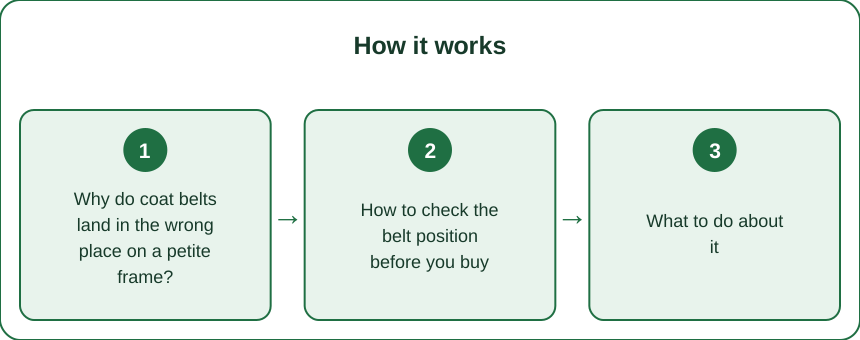
Why do coat belts land in the wrong place on a petite frame?
Because the loops are positioned by the pattern, not by your body.
Garment blocks are drafted around a standard height, typically around 168 to 170 centimetres for regular sizing. Every horizontal feature — belt loops, pocket placement, button positions, seam lines — is spaced from that assumption.
When the wearer is shorter, all those features stay where they are relative to the garment and move downward relative to the body. The shoulders may fit, because shoulder width is graded by size rather than height. The waist definition does not, because it is graded by height and the height is wrong.
A belt intended for the natural waist ends up somewhere between the waist and the hip, and often at the widest part of the hip. Three things follow:
The body is divided low. The eye reads leg length from the strongest horizontal line, so a belt at hip level starts the legs at the hip. On a shorter frame, where every centimetre of apparent leg length matters more proportionally, this is costly.
Fabric bunches where it should drape. Cinching a coat below the natural waist gathers the fullness at the widest point instead of the narrowest, which adds visual volume precisely where the coat should be skimming.
The coat reads as unstructured. Belted coats look tailored when the belt confirms the body’s shape. Belted below the waist, the same coat reads as a robe — the specific complaint people describe without being able to name the cause.
Is this true of petite-labelled coats too?
Petite ranges generally do raise the waist, and how much varies considerably between brands. It is worth checking rather than assuming, and the belt is the fastest thing to check.
How to check the belt position before you buy
Thirty seconds in the fitting room, and it tells you more than the size label.
Find your natural waist first. Bend sideways — the crease that forms is your natural waist. It is usually higher than people expect, often noticeably above the navel. This is where a belt should sit for the most flattering division.
Put the coat on and look at the loops, not the fit. Are the belt loops at that crease, or below it? If they sit more than a couple of centimetres low, the coat is drafted for a longer torso.
Do the tie test. Ignore the loops entirely and tie the belt at your natural waist. If the coat immediately looks better — and it usually does — the loops were the problem, and the problem is solvable.
Check the pockets while you are there. Pocket position is graded from the same assumption. Pockets that sit low enough to be awkward to use are confirming the same diagnosis, and unlike the belt they are much harder to move.
Look at where the coat nips. Some coats have shaping seams that create waist definition independently of the belt. If those seams also sit low, the coat is fighting you in two places and no amount of belt adjustment fixes it.
What if the shoulders fit perfectly and everything else is low?
That is the classic petite situation and it is the most fixable one. Shoulders are the hardest thing to alter, so a coat with correct shoulders and low horizontals is a better starting point than the reverse.
What to do about it
In order of effort.
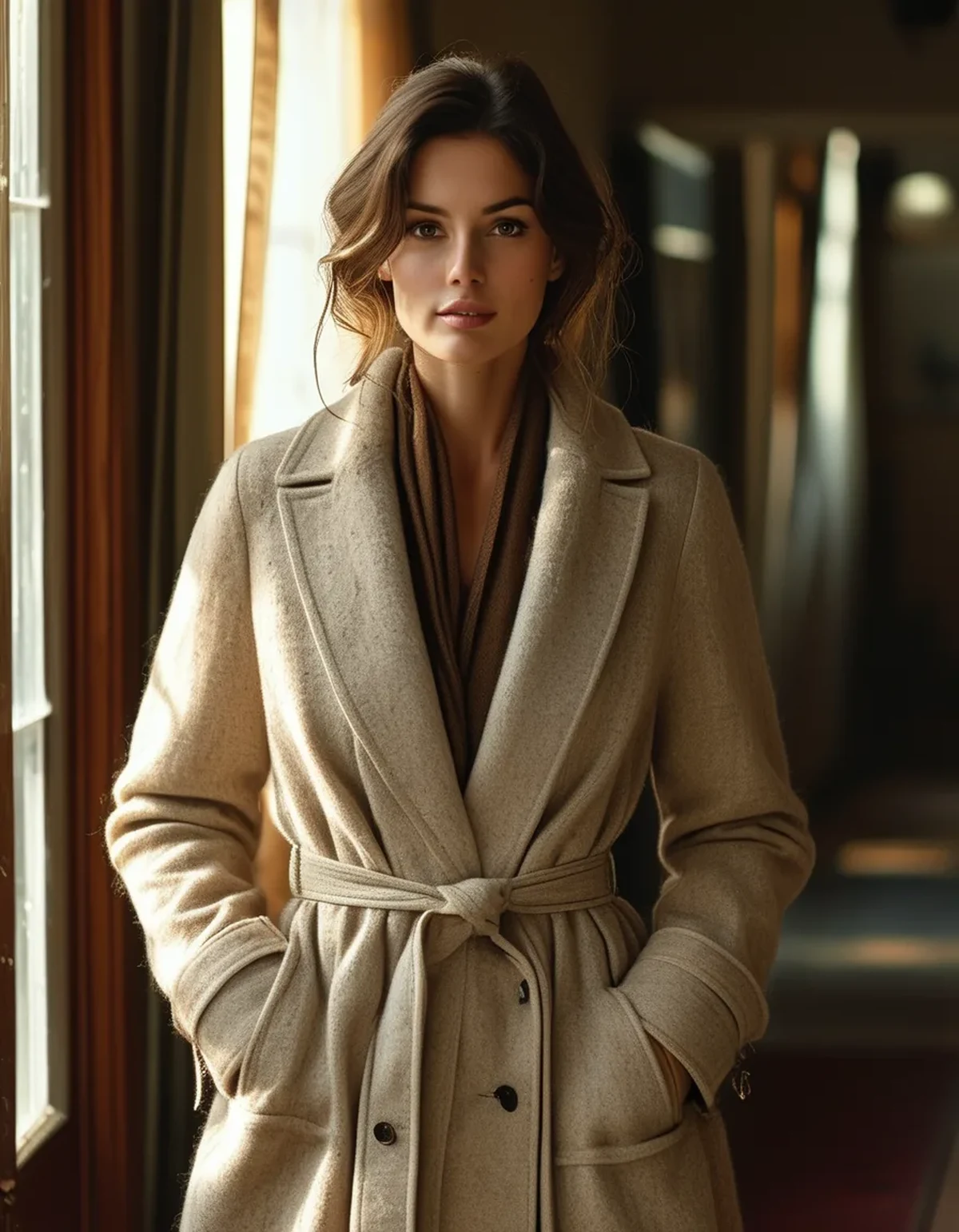
1. Ignore the loops. The simplest solution and the one people resist because the loops feel like instructions. They are not. Tie the belt at your natural waist and let it sit above the loops. On most wrap and tie coats this looks entirely intentional.
2. Tie it at the back or the side. A belt tied at the back removes the bulk of a front knot and keeps a clean line, which is particularly useful on shorter frames where a large front bow occupies a significant proportion of the torso. A side tie sits somewhere between the two.
3. Have the loops moved. For a coat you love, this is a quick and inexpensive alteration — usually a few minutes of work for an alterations tailor. Moving loops up by four to six centimetres transforms most belted coats on a petite frame.
4. Replace the belt with a narrower one. Wide self-fabric belts add bulk. A narrower belt in the same tone, worn higher, defines without occupying, and the effect on proportion is immediate.
5. Skip the belt entirely and let the coat hang. Not every coat needs cinching. A straight or slightly A-line coat worn open over a defined waist underneath can read longer than the same coat belted low.
6. Buy the coat for the shoulders and fix the rest. Shoulders and sleeve head are the expensive alterations. Belt loops, hem, and sleeve length are the cheap ones. Prioritize accordingly.
How short should the coat itself be?
There is no universal rule, and the useful principle is to avoid a hem that cuts across the widest part of the calf. Just above or just below the knee both tend to work; mid-calf on a shorter frame is the length that most often reads heavy.
What nobody tells you about petite outerwear
The lining tells you how the coat was made. A coat with a proper full lining and clean interior finishing usually has better structure through the shoulder and chest, which is what makes a coat hold its shape on a smaller frame. Structure does more for proportion than fabric weight does.
Bulk is the real enemy, not length. A long coat on a shorter frame can look excellent if it is slim. A short coat in a very heavy, stiff fabric often looks worse, because volume reads as scale and scale is what overwhelms a smaller frame.
The collar is a proportion decision. Large collars, wide lapels, and oversized hoods occupy a substantial share of the visible upper body on a petite frame. A smaller collar leaves more visible neck, which lengthens.
Sleeve length is the most visible unfinished detail. A sleeve that covers half the hand undermines an otherwise well-fitting coat instantly, and shortening a sleeve is among the most straightforward alterations available. It is worth doing on day one rather than living with it.
Cuff turnbacks are a free adjustment. Many coat sleeves can be turned back to create a deliberate cuff, which solves length while looking like a design choice. This works particularly well on coats with contrasting lining.
Two well-altered coats beat five unaltered ones. Outerwear is the most visible thing you own during autumn and winter, worn over everything else. It is the highest-return category for spending money on alterations.
FAQ: Petite Coat Questions, Answered
How much does moving belt loops usually cost?
It is one of the simpler alterations and is typically among the cheapest a tailor will quote. Worth asking about for any coat you intend to keep.
Should I only buy from petite ranges?
Not necessarily. Petite ranges usually get the vertical proportions closer, and regular sizing with well-chosen alterations often gives more selection. The belt and sleeve are the two things to check either way.
Does this apply to trench coats specifically?
Trenches are the most affected category, because they combine a belt, a wide collar, epaulettes, storm flaps, and length — five features drafted for a taller frame. They are also the ones that improve most dramatically when the belt is repositioned.
What about belting a coat over bulky knitwear?
Bulk under a belt gathers at the waist and adds visual width. Slimmer layers under a belted coat, and heavier knits under an unbelted one, is a useful default.
Is a tonal belt better than a contrasting one?
For lengthening, yes — a belt matching the coat keeps the vertical line unbroken. A contrasting belt draws attention to the waist, which is a valid choice when the waist is where you want the eye.
What single check should I do in the shop?
Tie the belt at your natural waist, ignoring the loops entirely, and look in the mirror. If that looks right, the coat is worth buying and altering.
TL;DR:
- Belt loops are positioned for a standard height, so they land at the hip rather than the waist on a petite frame.
- A belt at hip level shortens the leg line and bunches fabric at the widest point.
- Ignore the loops and tie at your natural waist — this is free and usually sufficient.
- Moving belt loops up four to six centimetres is a cheap, fast alteration for coats worth keeping.
- Buy for the shoulders; belt, hem, and sleeve are all inexpensive to fix.
The coat was drafted for someone taller, and only in the horizontal directions. Move the one line that matters and it becomes your coat.
This is general information, not medical advice.
See It in Motion
Seen here: High Waist Yoga Leggings with Side Pockets — shop it on bubblelime.com
Keep Reading
This article is for general informational and styling purposes only. Fit, sizing, and product availability may vary.