Why Petite Coats Fail at the Armhole, Not at the Hem
Quick Answer: Petite sizing shortens the vertical measurements of the body - torso, arm, rise - but many regular-size coats keep a deep armhole that sits several inches below where a shorter torso needs it. A low armhole restricts arm movement, adds bulk under the arm, and drops the whole shoulder line, which reads as a coat that is too big regardless of what the shoulder seam is doing. Check the armhole depth before the sleeve length, because sleeves are easy to alter and armholes are not.
The shoulders fit. The length is right after tailoring. The coat still looks like it belongs to someone else.
Raise your arms and you will find out why in about two seconds.

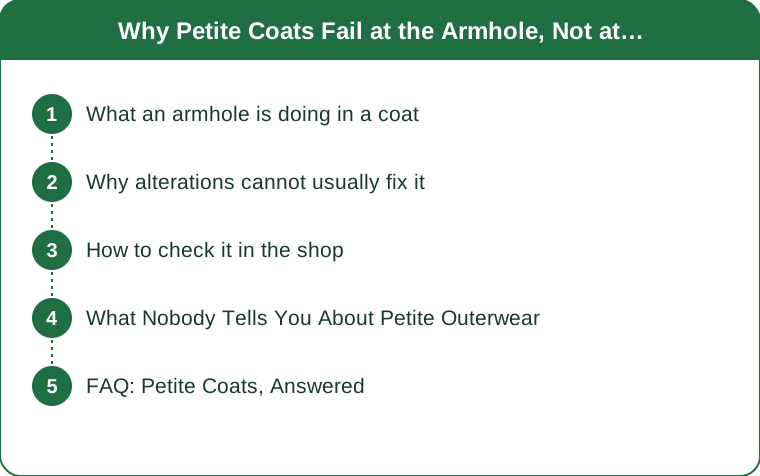
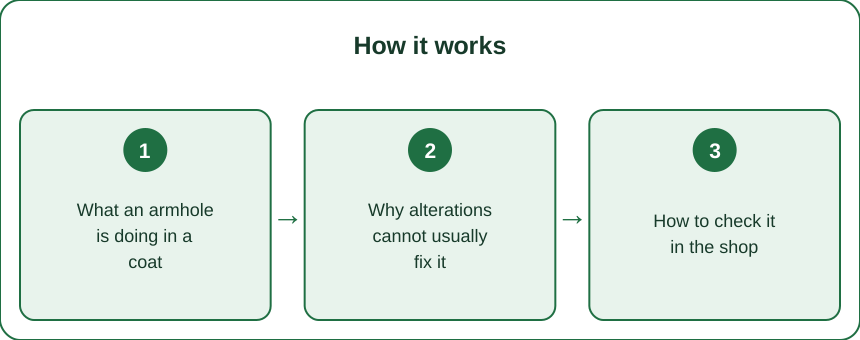
What an armhole is doing in a coat
The armhole determines both the range of motion and the visual line of the shoulder. A higher armhole allows the arm to move without lifting the whole garment; a lower one forces the coat body up whenever you raise your arm.
Regular sizing places the armhole for an average torso length, and a petite frame has less vertical space between shoulder and waist for it to occupy.
A too-low armhole pushes fabric into the underarm, which creates bulk that shows from the front as horizontal wrinkles radiating out from under the arm.
It also drops the apparent shoulder line, which makes the shoulder read as wider and lower than it is - the single most common reason a coat looks oversized on a petite frame even when the shoulder seam sits correctly.
And it shortens the effective torso even further, because the visual distance from armhole to hem is what the eye uses to judge proportion in outerwear.
Why alterations cannot usually fix it
Raising an armhole means dismantling and reconstructing the sleeve, the side seam and often the lining, which is among the more expensive alterations available and frequently exceeds what the coat is worth.
Sleeve length, hem length and even shoulder width are far more tractable. These are the alterations tailors do routinely and inexpensively.
A coat with a good armhole and a long sleeve is a twenty-minute alteration. A coat with a great sleeve and a low armhole is a project.
Which reverses the usual shopping order. Most people check length first, because it is the most visible mismatch. Checking the armhole first saves both money and the coat you would have bought and never worn.
Structured coats are the hardest to alter here because the armhole is built with interfacing, padding and a set sleeve. Unstructured and raglan styles have more give.

How to check it in the shop
Put the coat on and raise both arms to shoulder height. If the whole coat lifts noticeably with your arms, the armhole is too low.
Reach forward as if for a steering wheel. Restriction across the back or a pulling sensation at the shoulder indicates the armhole is fighting you rather than moving with you.
Put two fingers into the underarm. More than a few inches of space between your armpit and the seam is a warning sign for a petite frame.
Check for horizontal wrinkles from the underarm toward the chest while standing normally. That is excess fabric with nowhere to go.
Then check the shoulder seam, which should sit at the edge of your shoulder. A correct shoulder with a low armhole still produces a poor result, which is why the two need checking separately.
And do all of this with what you would actually wear underneath. A coat checked over a t-shirt behaves differently over a chunky knit, and outerwear is the category where that difference matters most.
What Nobody Tells You About Petite Outerwear
Petite lines vary enormously in what they actually change. Some brands shorten only the hem and the sleeve; the better ones also raise the armhole, shorten the torso and reposition the pockets and buttons. Two coats labelled petite can be entirely different garments.
Pocket position gives the game away. If the pockets sit low enough that your hand has to reach down awkwardly, the pattern was scaled rather than redrafted, which usually means the armhole was not addressed either.
Button placement is the second tell. A top button sitting too low on the chest indicates a torso that was not shortened where it needed to be.
Raglan and drop-shoulder styles are more forgiving, because the armhole is not a fixed circle in the same way. They are a genuinely useful category when a set-in sleeve does not work.
Children’s and teen outerwear is not the answer, despite the frequent suggestion - the shoulder, bust and hip proportions are different in ways that produce a worse fit, not a better one.
And buying the coat that fits the shoulders and armholes then altering everything else is nearly always the right strategy, even when it means a size that looks wrong on the hanger.
FAQ: Petite Coats, Answered
How do I know if the armhole is too low without a mirror?
Raise your arms. If the hem of the coat lifts more than a couple of inches, the armhole is doing it.
Is it worth altering a coat with a low armhole?
Usually not. It is one of the few alterations that regularly costs more than the garment’s value and still produces a compromise.
Should I always buy petite outerwear?
Not always - check the specific coat rather than the label. A well-cut regular coat with a high armhole can beat a poorly executed petite one.
What length works best on a petite frame?
The reliable rule is to avoid hems ending at the widest part of the hip or mid-calf. Above the knee or a full long line both tend to work; the middle is where proportion breaks.
What about oversized coats, which are everywhere right now?
Oversized works on a petite frame when the shoulder and armhole are still correct and only the body is generous. Oversized everywhere reads as borrowed rather than as a deliberate silhouette.
TL;DR:
- The armhole, not the hem, is where regular-size coats fail on a petite frame.
- A low armhole restricts movement, adds underarm bulk and drops the apparent shoulder line.
- Raising an armhole is an expensive, often impractical alteration; sleeves and hems are simple.
- Check by raising your arms - if the coat lifts noticeably, walk away - and always try it over what you would really wear.
- Low pockets and a low top button reveal a pattern that was scaled rather than redrafted.
Buy for the shoulder and armhole and alter everything else, even if the size looks wrong on the hanger.
See It in Motion
Seen here: High Waist Printed Bootcut Yoga Pants with Pockets — shop it on bubblelime.com
Keep Reading
This article is for general informational and styling purposes only. Fit, sizing, and product availability may vary.