Why Sleeve Cuff Position Decides Whether a Petite Jacket Looks Tailored
Quick Answer: The eye reads tailoring from where the sleeve ends relative to the wrist bone - it should sit at or just above the wrist bone, exposing a small amount of hand. On petite frames, standard sleeves overshoot by 3 to 5cm, and that overshoot covers the wrist entirely, which reads as a garment made for someone else. Sleeve length is the cheapest alteration in tailoring and the one with the largest visual return, and it usually costs less than a pair of socks.
Which makes it the highest-value thing to fix on almost any petite jacket.

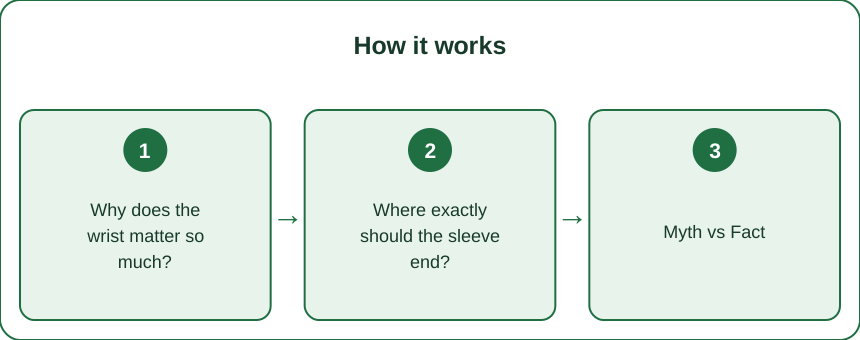
Why does the wrist matter so much?
Because it is one of the few reliable proportion references the eye has.
The wrist bone is a fixed anatomical landmark. Unlike a hem, which depends on style, the wrist is a proportion anchor the eye uses to calibrate whether a garment matches the body wearing it. A sleeve ending at the correct point signals that the garment was made for you.
Covering the wrist removes the reference and adds visual length. When the sleeve extends past the wrist, the arm reads as shorter and the garment as larger - which is exactly the impression a petite frame is usually trying to avoid.
A small amount of visible hand creates a break. Roughly 1 to 2cm of hand showing beyond the cuff gives the eye a clear termination point. This is why a quarter-inch of shirt cuff below a jacket sleeve is a menswear tailoring rule - it is the same principle.
And the shoulder cannot compensate. People often size down a jacket to fix the sleeves, which produces a jacket that pulls across the back and shoulders. Sleeve length and shoulder width are separate problems needing separate solutions, and only one of them is easily altered.
Note the specific overshoot on petite frames: standard sizing assumes a longer arm relative to torso, so the excess is typically 3 to 5cm - which is nearly always past the point where it stops looking deliberate.
Where exactly should the sleeve end?
The rules differ by garment, and they are more specific than most people realise.
Blazer or tailored jacket: at the wrist bone, with roughly 1cm of hand visible. If wearing a shirt beneath, about 1cm of shirt cuff should show below the jacket sleeve.
Casual jacket or denim jacket: at or slightly past the wrist bone. These tolerate a little more length, but not much - more than 2cm past reads as oversized rather than relaxed unless the whole garment is deliberately oversized.
Coat: slightly longer than a blazer, covering the wrist bone but not reaching the base of the thumb. A coat sleeve that reaches your knuckles is too long regardless of how cold it is.
Knitwear: at the wrist bone, unless the style is deliberately slouchy. Fine knits look best ending precisely; chunky knits tolerate a little more.
Three-quarter sleeve: at the narrowest point of the forearm, roughly two-thirds down. On petite frames this is genuinely flattering because it deliberately shows more wrist and forearm, lengthening the arm line.
A quick self-check: stand naturally with arms relaxed at your sides - do not hold them out, which changes the reading. Look in a mirror at where the cuff falls relative to the bump of your wrist bone. If the bone is covered, the sleeve is long.
Also check with arms bent to 90 degrees. A sleeve that is correct straight and rides up past the wrist when bent is slightly short for a tailored jacket, though usually fine for casual.

Myth vs Fact: Petite Sleeves
Myth: buy petite sizing and the sleeves will be right. Fact: petite ranges shorten sleeves, but by a standard amount based on an assumed proportion. If your arms are short relative to your height, or long relative to your torso, petite sizing can still be wrong - it is an improvement, not a guarantee.
Myth: pushing the sleeves up solves it. Fact: it is a legitimate styling choice and it works, but it only works with fabrics that hold a push and it is not available for a coat in January. A permanent fix beats a repeated adjustment.
Myth: sleeve alterations are expensive. Fact: shortening a plain sleeve is usually one of the cheapest alterations available. Sleeves with functional buttons or a lining cost more, and even those are typically well under the price difference between a good jacket and a badly fitting one.
Myth: you should size down to fix the sleeves. Fact: this trades a fixable problem for an unfixable one. Shoulder width is difficult and expensive to alter; sleeve length is easy. Always buy to the shoulder.
Myth: a long sleeve is more forgiving. Fact: the opposite. A too-long sleeve is the single most reliable signal that a garment does not fit, more so than a slightly loose body, because the wrist gives the eye a precise reference to check it against.
What should you actually do?
A short practical sequence for petite outerwear.
1. Buy to the shoulder, always. The shoulder seam should sit at the edge of your shoulder. Everything else is negotiable; this is not - a shoulder alteration on a lined jacket costs more than most jackets are worth.
2. Budget for a sleeve alteration on anything you love. Treat it as part of the purchase price. A jacket that fits everywhere except the sleeves is a jacket plus a small tailoring bill, and it will look substantially better than an unaltered one that technically fit.
3. Check whether the sleeve can be shortened from the shoulder on structured jackets with detailed cuffs. A good tailor can shorten from the top, preserving cuff buttons and vents. It costs more and it is the right answer for a jacket with real detailing.
4. Favour three-quarter and bracelet sleeves. They sidestep the problem entirely and deliberately expose the wrist, which lengthens the arm line - genuinely one of the most flattering options on a petite frame.
5. Watch the cuff detail when buying. A plain sleeve is trivial to alter. Functional buttonholes, zips, storm cuffs, and knit ribbing are progressively harder - factor that into whether a jacket is worth buying.
6. Check armhole height while you are at it. Petite frames often need a higher armhole, and a low armhole restricts arm movement more than a tight body does. Raise your arms in the changing room - if the whole jacket lifts, the armhole is too low.
As autumn jacket-buying season starts, this is worth deciding before you shop rather than after: one well-altered jacket beats three unaltered ones, and it is usually cheaper too.
FAQ: Petite Sleeve Length, Answered
Where should a blazer sleeve end?
At the wrist bone, with roughly a centimetre of hand visible. If wearing a shirt underneath, about a centimetre of shirt cuff should show below the jacket sleeve.
How much do petite ranges shorten the sleeve?
A standard amount based on an assumed proportion. It helps most people, but if your arm length is unusual relative to your height, petite sizing alone may still leave you long or short.
Is it worth altering an inexpensive jacket?
Often yes - a plain sleeve shortening is one of the cheapest alterations available, and the visual difference is larger than almost any other change you can make to a garment.
Should I size down to fix long sleeves?
No. That creates shoulder and back fit problems that are expensive or impossible to correct. Buy to the shoulder and alter the sleeve.
What about coat sleeves?
Slightly longer than a blazer - covering the wrist bone but not reaching the base of the thumb. A sleeve at your knuckles is too long regardless of the weather.
Are three-quarter sleeves better on petite frames?
Often, yes. Ending at the narrowest part of the forearm deliberately exposes the wrist, which lengthens the arm line and avoids the too-long problem entirely.
TL;DR:
- The eye uses the wrist bone as a proportion anchor - a sleeve covering it reads as a garment made for someone else.
- Target: at the wrist bone with about 1cm of hand visible; a coat slightly longer; three-quarter at the narrowest forearm point.
- Petite frames typically overshoot by 3 to 5cm, which is well past deliberate.
- Buy to the shoulder and alter the sleeve - shoulder width is expensive to change, sleeve length is cheap.
- Plain sleeves alter easily; functional buttons, zips, and storm cuffs cost more - factor it in before buying.
- Check the armhole height too: if the jacket lifts when you raise your arms, it is too low.
One alteration, usually the price of a coffee round, and the same jacket reads as tailored. It is the best value in the whole wardrobe.
See It in Motion
Seen here: Bootcut Capri Yoga Pants with Pockets — shop similar styles on bubblelime.com
Keep Reading
This article is for general informational and styling purposes only. Fit, sizing, and product availability may vary.