Why the Shoulder Seam Decides Whether a Coat Works on a Petite Frame
Quick Answer: A shoulder seam that sits past your actual shoulder point makes any coat read as borrowed, and it is the single alteration that is either impossible or prohibitively expensive on most garments. Check it before length, before sleeve, before everything. If the seam lands within about half an inch of your shoulder point, the rest is tailorable — if it does not, the coat is not yours regardless of how good the price is.
The coat was 60 percent off and almost right.
Six months later it is still hanging in your closet looking like you borrowed it, because the one thing wrong with it was the one thing that cannot be fixed.

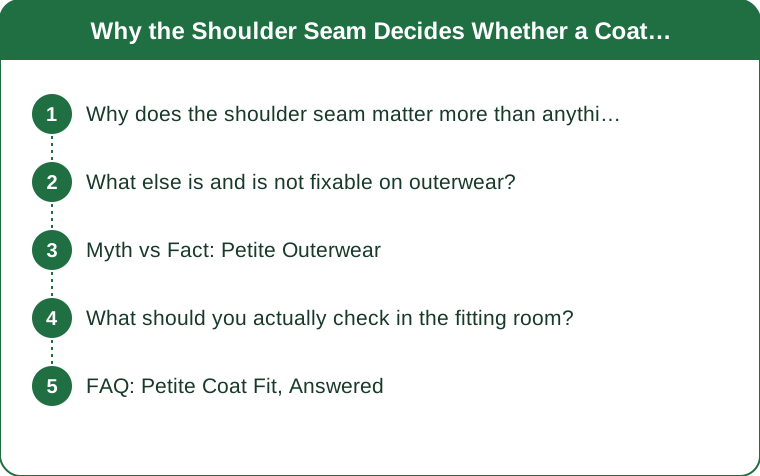
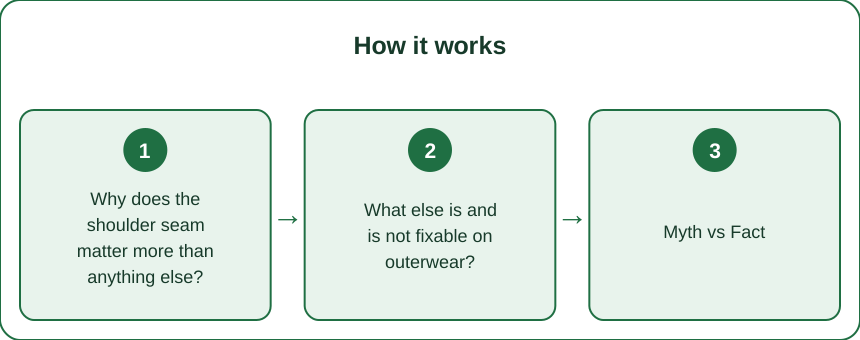
Why does the shoulder seam matter more than anything else?
Because it sets every other line in the garment, and it is effectively unfixable.
The shoulder is the hanger point. Everything below it — the drape of the chest, where the armhole sits, how the sleeve falls, where the waist lands — hangs from that seam. Get it wrong and every other measurement is being measured from the wrong starting point.
A dropped seam adds visual width exactly where you do not want it. On a petite frame, a seam sitting an inch past the shoulder point reads as a wider, softer, less defined upper body, and it pushes the whole silhouette toward looking oversized rather than fitted.
Moving a shoulder seam means rebuilding the garment. It requires detaching the sleeve, reshaping the armhole, and reattaching — which on a lined coat is most of the cost of the coat. Most tailors will quote you a number that ends the conversation.
Sleeve length is a completely different story. Sleeves shorten easily and cheaply, which is why a coat with correct shoulders and long sleeves is a good buy and the reverse never is.
How to check it in 5 seconds: find the bony point at the top of your arm where it meets your shoulder. The seam should sit within about half an inch of it. Further out than that and the answer is no.
What else is and is not fixable on outerwear?
Knowing the list changes how you shop, because it tells you which compromises are actually compromises.
Easily fixable: sleeve length. Straightforward on most coats, moderately more involved on ones with buttons or vents at the cuff, but still routine work.
Easily fixable: hem length. Simple on an unlined or straight-hemmed coat. More complex on a curved or shaped hem, and expensive on anything with a lot of structure.
Moderately fixable: waist and body width. Taking in the side seams and back seam works well within a couple of inches, though it can distort pocket placement if you go further.
Difficult and rarely worth it: armhole height. A low armhole restricts arm movement and is a common petite problem, but raising it means reconstructing the sleeve attachment — the same expensive work as the shoulder.
Effectively impossible: shoulder width, collar proportion, and pocket placement. These are built into the garment’s architecture. A collar that overwhelms a petite frame stays overwhelming, and pockets that hit at the wrong point stay wrong.
The shopping rule that follows: buy for shoulders, collar, and pockets. Everything else is negotiable with a tailor and a modest budget.

Myth vs Fact: Petite Outerwear
Myth: Buying petite-labeled outerwear guarantees the shoulders will fit. Fact: Petite sizing scales overall proportions, but shoulder width varies enormously between people of the same height. Plenty of petite-labeled coats have shoulders cut for a broader frame, and plenty of regular-line coats fit a petite shoulder perfectly. Always check the seam rather than trusting the label.
Myth: An oversized coat is supposed to have dropped shoulders, so the rule does not apply. Fact: Intentional drop-shoulder designs are a real category, and they can work on a petite frame — but only when the drop is deliberate and consistent, with a matching sleeve cut. An accidentally-too-big shoulder on a structured coat is not the same thing and does not read the same way.
Myth: You need to size down to get the shoulders right. Fact: Sizing down often gets the shoulder closer but makes the body too tight to layer over a sweater, which defeats the purpose of a coat. Different brands cut shoulders differently at the same size — finding a brand whose shoulder geometry matches yours is worth more than any sizing trick.
Myth: A shorter coat always works better on a petite frame. Fact: Length is far less decisive than proportion. A long coat with correct shoulders and a defined waist elongates beautifully. A cropped coat with dropped shoulders looks worse than either. Shoulders decide; length adjusts.
Myth: Tailoring a cheap coat is a waste of money. Fact: A $120 coat with perfect shoulders plus $60 of sleeve and hem work outperforms a $400 coat with wrong shoulders every time. Spend on the fit you cannot change and tailor the rest.
What should you actually check in the fitting room?
Five checks in order, and the first one is a gate — if it fails, put it back.
First, the shoulder seam. Find your shoulder point, look at where the seam lands. Half an inch of tolerance. If it is out by an inch, stop here.
Second, raise both arms straight forward. If the whole coat lifts with them, the armhole is too low. This is the difference between a coat you wear and one you take off in the car.
Third, the collar against your neck and jaw. A large collar on a petite frame reads as the coat wearing you. Look at the proportion relative to your face, not to the coat.
Fourth, pocket placement. Pockets that sit at your hip on a taller model may sit at your upper thigh on you, which cuts the line at a bad point and looks like an error even when everything else is right.
Fifth, and only fifth, the length and sleeves. Both are tailorable, so these are notes for the tailor rather than reasons to reject. Try it on over the thickest sweater you actually wear — a coat that fits over a t-shirt in September is the classic autumn shopping mistake, and you discover it in December.
FAQ: Petite Coat Fit, Answered
How much should tailoring cost?
Sleeve shortening on a lined coat typically runs $40 to $80 depending on cuff construction, and a hem is broadly similar. Taking in the body runs higher. Budget roughly $100 to $150 for a coat needing sleeves and hem, and factor that into what you are willing to pay for the coat itself.
What if the shoulders fit but the coat is enormous everywhere else?
That is the good version of the problem. Shoulders correct with a too-large body is straightforwardly tailorable within two sizes. Shoulders wrong with a perfect body is not. If you have to choose, always choose the first.
Are there brands that cut petite shoulders better?
There is no universal answer, because shoulder width varies independently of height. The practical approach is to find two or three brands whose shoulder geometry matches yours and then shop those first every season. That is more useful than any general recommendation, and once you know, coat shopping takes twenty minutes instead of a full day.
TL;DR:
- The shoulder seam should land within half an inch of your shoulder point — check it before anything else
- Shoulder width, collar proportion, and pocket placement are effectively unfixable; sleeves and hems are easy
- A cheap coat with right shoulders plus tailoring beats an expensive coat with wrong ones
- Raise your arms in the fitting room to test the armhole, and try it over your actual winter sweater
- Petite labeling does not guarantee the shoulder; find brands whose shoulder geometry matches yours
The whole reason this matters is that the shoulder is the one thing money cannot fix after the fact. Get it right at the rack and everything else is a conversation with a tailor.
See It in Motion
Seen here: High Waist 8” Yoga Shorts — shop similar styles on bubblelime.com
Keep Reading
This article is for general informational and styling purposes only. Fit, sizing, and product availability may vary.