Why Petite Jackets Fit the Body But Not the Arms
Quick Answer: Sleeve length is graded from the shoulder point down and is tied to overall height in a manufacturer’s size chart, while body length and width are graded from a torso block. Petite lines usually shorten the body and the hem correctly but under-adjust the sleeve, because shortening a sleeve properly requires moving the elbow dart and the cuff detail, not just cutting length off the end. The result is a jacket that fits everywhere except the arms — which is also the easiest fit problem to have altered.
Once you know why it happens, you can spot which jackets will alter well and which will not, before you buy.

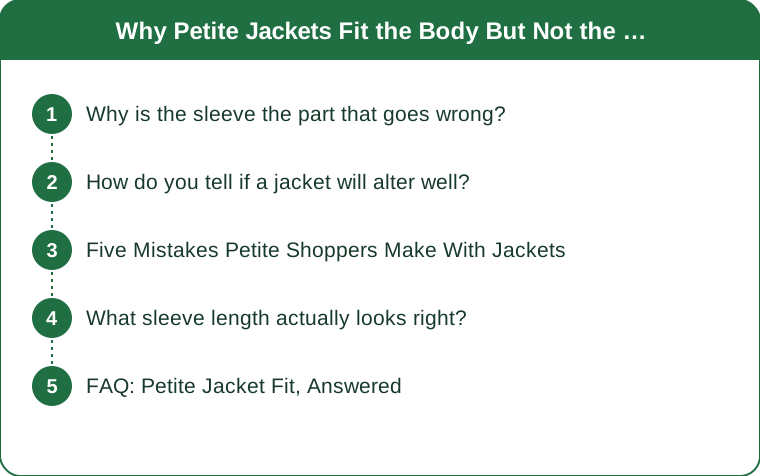
Why is the sleeve the part that goes wrong?
Because it is the most expensive part of the pattern to grade properly.
A jacket sleeve is not a tube. It has a sleeve cap shaped to fit the armhole, an elbow position where the fabric is shaped or darted to allow bending, and often a cuff detail — buttons, a vent, a turnback — placed a fixed distance from the hem.
Shortening a sleeve correctly means moving all three. The cap stays where it is, but the elbow shaping has to move up proportionally, and the cuff detail has to be repositioned. That is a full pattern re-draft, not a size adjustment, and it is why many petite lines shorten the body properly and take a token amount off the sleeve.
The consequence is a sleeve that is too long overall and, more subtly, one where the elbow shaping sits below your actual elbow. That second problem is what causes the sleeve to bunch at the crook of the arm and pull across the back when you reach forward.
There is also a commercial factor. Sleeve length is the least visible dimension in a flat product photo, so it is the dimension most likely to be treated as a rounding error in a size chart. Shoulder width and body length show up in photographs immediately; sleeve length does not.
How do you tell if a jacket will alter well?
Look at the cuff and the lining before anything else.
A plain cuff with no vent, no buttons, and no turnback is the easiest possible alteration. A tailor shortens from the hem, and there is nothing to reposition. This is a 20-minute job at low cost.
A functional buttonhole cuff — where the buttons actually unbutton — is the hardest and most expensive, because shortening from the hem destroys the buttonhole placement. The alteration has to be done from the shoulder instead, which means detaching and re-setting the sleeve. Expect a significantly higher cost.
A vented cuff with non-functional buttons sits in between. It can be shortened from the hem up to about 2.5cm before the vent proportion looks wrong; beyond that, the vent has to be rebuilt.
Check for a lining. A lined sleeve requires the lining to be shortened too, which adds time but is routine. An unlined sleeve with a visible finished edge may need that edge recreated.
And measure how much you need. Up to about 4cm can be taken from the hem on most simple sleeves. More than that and the sleeve starts to taper wrongly — the cuff opening ends up too wide for its new position, since sleeves narrow toward the wrist.

Five Mistakes Petite Shoppers Make With Jackets
Sizing down to fix the sleeve. A smaller size shortens the sleeve slightly and also narrows the shoulder, and shoulder width is the one dimension that cannot be altered affordably. Buy for the shoulder, always, and alter everything else.
Assuming petite lines are consistent. Petite grading rules vary enormously between brands — some shorten sleeves by 2cm, some by 5cm, some barely at all. A brand’s petite line that works for you is worth returning to; the label alone guarantees nothing.
Judging sleeve length with arms down. Sleeves ride up when you bend and reach. A sleeve that looks correct hanging straight will be short in use. Check with your arm bent at 90 degrees — the cuff should still reach the wrist bone.
Ignoring the sleeve width. A sleeve that is too long is usually also too wide, because both scale with the size. A shortened sleeve that is still wide reads as borrowed rather than tailored, and slimming the sleeve is a separate alteration worth asking about at the same time.
Forgetting the shirt underneath. The convention is roughly 1 to 1.5cm of shirt cuff showing below the jacket sleeve. If you alter the jacket without checking against the shirts you actually wear, you can end up with a jacket that only works over short sleeves.
What sleeve length actually looks right?
There is a standard, and it is easy to check yourself.
The jacket sleeve should end at the wrist bone — the prominent bone on the outside of your wrist. With your arms hanging naturally, the cuff sits right at or just past that point, exposing the hand fully.
A sleeve that covers part of the hand does two things, both bad for proportion. It visually shortens the arm, and it makes the whole jacket read as oversized regardless of how well the body fits. On a petite frame this is particularly costly, because the arm is one of the strongest cues the eye uses to judge overall scale.
There is a useful secondary check. Hold your arm out straight in front of you. The cuff should not slide more than about 2cm up your forearm. If it stays put entirely, the sleeve is likely too narrow at the elbow.
For autumn coats the rule shifts slightly. A coat sleeve should sit about 1cm longer than a jacket sleeve, because it goes over a jacket or a heavy knit and needs the extra room. Altering a coat to the jacket standard is a common and frustrating mistake.
And for casual outerwear the rule relaxes further — a bomber or utility jacket with a ribbed cuff is designed to sit at or slightly past the wrist and bunch. That is the intended look, not a fit failure, and shortening it removes the design detail entirely.
FAQ: Petite Jacket Fit, Answered
Is it worth altering a mid-price jacket?
Usually yes. A simple sleeve shortening typically costs a small fraction of the jacket price and changes how it reads more than almost any other alteration. The economics only stop making sense on very inexpensive jackets or functional buttonhole cuffs.
Can shoulders ever be altered?
Yes, but it is the most expensive common alteration because the sleeve has to come off and go back on, and on a structured jacket the shoulder pad and canvas are involved too. It is generally worth doing only on a garment you love or that has real value.
Should I buy petite or regular and alter?
Petite when the shoulders and armhole position fit, which is the real advantage of petite grading — the armhole sits higher, which is difficult to alter. If a regular size fits your shoulders better, buy it and alter the length.
TL;DR:
- Sleeves fit badly because proper shortening means moving the elbow shaping and cuff detail, not just cutting the end.
- Buy for the shoulder — it is the one dimension that is expensive to change.
- Plain cuffs alter easily; functional buttonhole cuffs are costly because the work moves to the shoulder.
- The sleeve should end at the wrist bone, and a coat sleeve about 1cm longer than a jacket sleeve.
Check the cuff construction on any jacket before you buy. That thirty-second look tells you whether the fit problem you can see is a cheap fix or an expensive one.
See It in Motion
Seen here: High Waist Yoga Leggings with Side Pockets — shop it on bubblelime.com
Keep Reading
This article is for general informational and styling purposes only. Fit, sizing, and product availability may vary.